For all those businesses drowning in compliance tasks, an effective continuous monitoring program promises relief. But here's the brutal truth: Most people trying to "automate compliance" just swap one set of manual tasks for another. You're no longer hunting screenshots, but you're still buried in alerts from your compliance monitoring system, remediation tickets, and audit coordination.
So, let’s break down why traditional periodic compliance fails, what most "continuous compliance" platforms get wrong, and how to implement an approach that actually works. We'll show you we’ve built Mycroft to combine automation, intelligence, and operational support to keep you secure and audit-ready without grinding your product roadmap to a halt.
The predictable chaos of periodic compliance
It's Q4. Your auditor just sent the evidence request list. Your engineering team (already underwater with the product roadmap) is now being pulled into Slack channels with messages like "URGENT: SOC 2 Evidence Needed." Sound familiar?
This is how most of the businesses I talk to approach their compliance processes: Ignore it for 11 months, then scramble when the audit deadline looms.
And it plays out in predictable patterns:
Employees diverted from core work: Engineers who should be shipping features are now hunting down screenshots of access logs from three months ago.
Frantic screenshot hunting across systems: Someone needs to prove you configured MFA correctly. Where did you document that again?
"Just get it done" mentality vs. actual security: The goal becomes passing the audit, not actually being secure.
In the end, everybody breathes a collective sigh of relief when you pass the audit, but it’s a brief moment of reprieve when you remain vulnerable 364 days a year.
This approach to compliance (treating it as a periodic hurdle to overcome and then forgetting about it until the next hurdle comes round) is fundamentally flawed. Not just because of the obvious cycle of panic it unnecessarily creates, but because it creates real dangers:
Compliance drift goes unnoticed for months: An employee leaves, but their access to production systems isn't revoked for six weeks. Your vulnerability scanner stops running, but nobody notices until audit prep begins.
Point-in-time evidence doesn't reflect real security posture: The screenshot from January showing proper access controls doesn't prove those controls were functioning correctly in April when a configuration change broke them.
Manual processes don't scale with growth: What worked when you had 20 employees and 5 systems becomes impossible at 100 employees and 30 integrations.
It only takes one incident to show that your controls aren't working: That incident just happens to occur between audits when nobody's looking.
There's a much better way to keep up with compliance standards all the time: Continuous compliance monitoring.
What is continuous compliance monitoring?
Continuous compliance monitoring means you always have real-time oversight of your security posture, with the system automatically checking that controls are functioning as designed and alerting you the moment something starts to drift out of line. Unlike periodic audits which give you snapshots of compliance at a certain point in time, continuous monitoring gives you a constant view of your security environment.
This ongoing visibility is built on four foundational capabilities:
Real-time visibility into compliance status across your entire stack
Automated evidence collection and control testing
Proactive alerting when drift or violations occur
Continuous validation that controls are functioning as designed
Why continuous compliance matters:
Regulatory requirements just keep getting tougher: NIS 2, GDPR, SOC 2, ISO 27001, CMMC—the list keeps growing, and each framework brings new obligations.
Modern infrastructure moves too fast for annual checks: Cloud environments, microservices, and rapid deployment cycles mean your infrastructure changes daily, not yearly.
The cost of non-compliance is 2.7x the cost of maintaining compliance (Ponemon Institute LLC): Between fines, breach response, and reputational damage, getting it wrong is expensive.
91% of organizations plan to implement continuous compliance within 5 years (Drata): The shift from periodic to continuous isn't a trend—it's inevitable.
Most organizations know they need continuous compliance. The question is: How do you actually achieve it? The conventional wisdom says, "Buy a GRC platform and automate everything." But that advice can be misleading.
The standard approach to continuous compliance (and why it’s not enough)
Most guidance follows a pretty well-worn pattern:
Pick a compliance automation platform (e.g., Vanta, Drata, etc.)
Map your controls to frameworks (SOC 2, ISO 27001)
Integrate your tools (AWS, Google Workspace, GitHub, etc.)
Turn on automated monitoring
Collect evidence automatically
Stay audit-ready
Why this sounds great on paper:
No more manual evidence gathering: No more asking engineers to take screenshots of their AWS configs or dig through logs from three months ago. The platform automatically captures and timestamps evidence as events occur.
Instant visibility: Instead of guessing whether you're compliant, you can see your compliance status at a glance. Red means action needed, green means you're good—simple.
Automates repetitive tasks: Policy reviews, access audits, vulnerability scans—all the routine compliance tasks run on schedules without human intervention.
Keeps you "always ready" for audits: When your auditor requests evidence, you can generate reports instantly instead of spending weeks gathering documentation.
On paper, this sounds like the perfect solution. Unfortunately, the reality is more complicated.
Where it falls short in practice
Here's what actually happens when you implement a typical continuous compliance platform:
1. Automation doesn't translate to intelligence
Automated checks will throw up red flags, but then you've got to figure out what they actually mean; someone still needs to contextualize them.
Your cloud scanner flags an open port. Is it a vulnerability or required for a specific integration? The tool can't tell you. You've traded manual evidence collection for manual triage and investigation.
2. Platform sprawl continues
Traditional continuous compliance platforms handle compliance reporting, but not compliance operations.
You still need:
A GRC platform for compliance tracking
Separate tool for cloud security (Wiz, Orca)
Another for vulnerability management (Qualys, Nessus)
MDM solution for device management (Kandji)
TPRM tool for vendor assessments
You thought you were simplifying your security ops, but what you really did was just add another layer to a system that's already way too complicated. Each new tool comes with its own learning curve, integration headaches, and operational overhead. Not quite the simplification you were hoping for.
The dirty secret of "automated compliance": You still need someone on your team to:
Configure and tune the integrations
Respond to alerts and remediate findings
Handle exceptions and edge cases
Talk to auditors and explain what's going on
Manage vendor risk assessments
Maintain policies and update controls
That's where most organizations run into trouble. They invested in automation, but their security and compliance teams are still too busy to get anything done. Just different tasks this time round.
4. Passing checks doesn't equal real security
Even if you pass all the automated tests, it doesn't mean your controls are actually any good:
Passing automated checks doesn't mean your controls are effective
Many tools optimize for "audit readiness" rather than actual risk reduction
You can be 100% compliant on paper while still being vulnerable in practice
Continuous compliance isn't just about having the right tools - it's about having the right way of working. This is what actually works:
The better way: Continuous compliance that actually works
True continuous compliance requires three layers:
Automation (tools and integrations)
Intelligence (context-aware monitoring and risk prioritization)
Operations (people who manage, tune, and remediate)
Most organizations focus on #1, dabble in #2, and sell out on #3.
Here’s what effective compliance really looks like:
One place to see everything
Instead of juggling multiple dashboards:
Centralized view of compliance posture across GRC, cloud security, application security, device management, and third-party risk
Single source of truth for control status, evidence, and remediation workflows
Real-time insights into drift, violations, and emerging risks
Think of it as a Risk Operations Center (ROC)—a centralized hub that doesn't just report on compliance, but actively manages it.
Context-aware monitoring, not just checks
Context-aware systems go beyond simple rule checking to understand what matters in your specific environment:
AI agents that understand your business context, not just generic rule sets
Intelligent prioritization based on actual risk (not just severity scores)
Automated evidence collection plus validation that controls are functioning as designed
Example: A traditional platform flags 50 medium-severity vulnerabilities across your cloud infrastructure. A context-aware system tells you which 5 actually expose customer data and require immediate remediation, and routes them to the right engineer automatically.
Continuous vendor risk management
Third-party risk doesn't pause between annual questionnaires. Effective continuous compliance extends monitoring to your entire vendor ecosystem:
Automated monitoring of third-party security posture (not just annual questionnaires)
Real-time alerts when vendor certifications lapse or breaches occur
Pre-filled security questionnaires that speed vendor assessments without sacrificing thoroughness
Integrated remediation workflows
Identifying issues is only half the battle; you need systems that drive them to resolution:
Findings don't just generate alerts—they create tickets, assign owners, and track resolution
Integration with tools your team already uses (Linear, Jira, Slack)
Closed-loop validation that remediation actually happened
Audit support that goes beyond documentation
In the end, mature continuous compliance programs do a lot more than just collect evidence; they actively manage the whole audit lifecycle:
It's not just a database of evidence, it's a system that really helps you manage the audit process
It interfaces with auditors, handles their requests for evidence, and helps keep everyone on track
We reduce the load on your internal team so they're not bogged down with compliance stuff
This is the model Mycroft was built around: A Risk Operations Center that combines platform automation with forward-deployed GRC engineers. You get the tools and the operational support—so your team can focus on building your product, not chasing compliance screenshots.
The business impact of doing it the better way
When you implement continuous compliance properly, the benefits extend far beyond "always audit-ready." Done right, continuous compliance becomes a strategic business enabler that impacts your bottom line, operational efficiency, and growth trajectory.
Cost comparison
The traditional "always-on" compliance stack can really add up. Here are some ballpark figures a startup-scale traditional stack (not full enterprise MSSP) can expect to pay annually:
GRC tool: $15k-30k
Cloud security scanner: $24k
MDM solution: $18k
MSSP for implementation help: $40k-60k
Pen testing: $10k-15k
TOTAL: $107k-147k / year
And then there's the deeper financial impact that goes beyond just chopping vendors. Think about it: what about the hidden costs of the traditional way of doing things? For example, how about the hours your engineers spend on product development instead of stuck on compliance? Then there's the issue of delayed enterprise deals because you "only" have time to "work on compliance"...And all the features that never see the light of day because your team's too busy prepping for audits.
Time savings
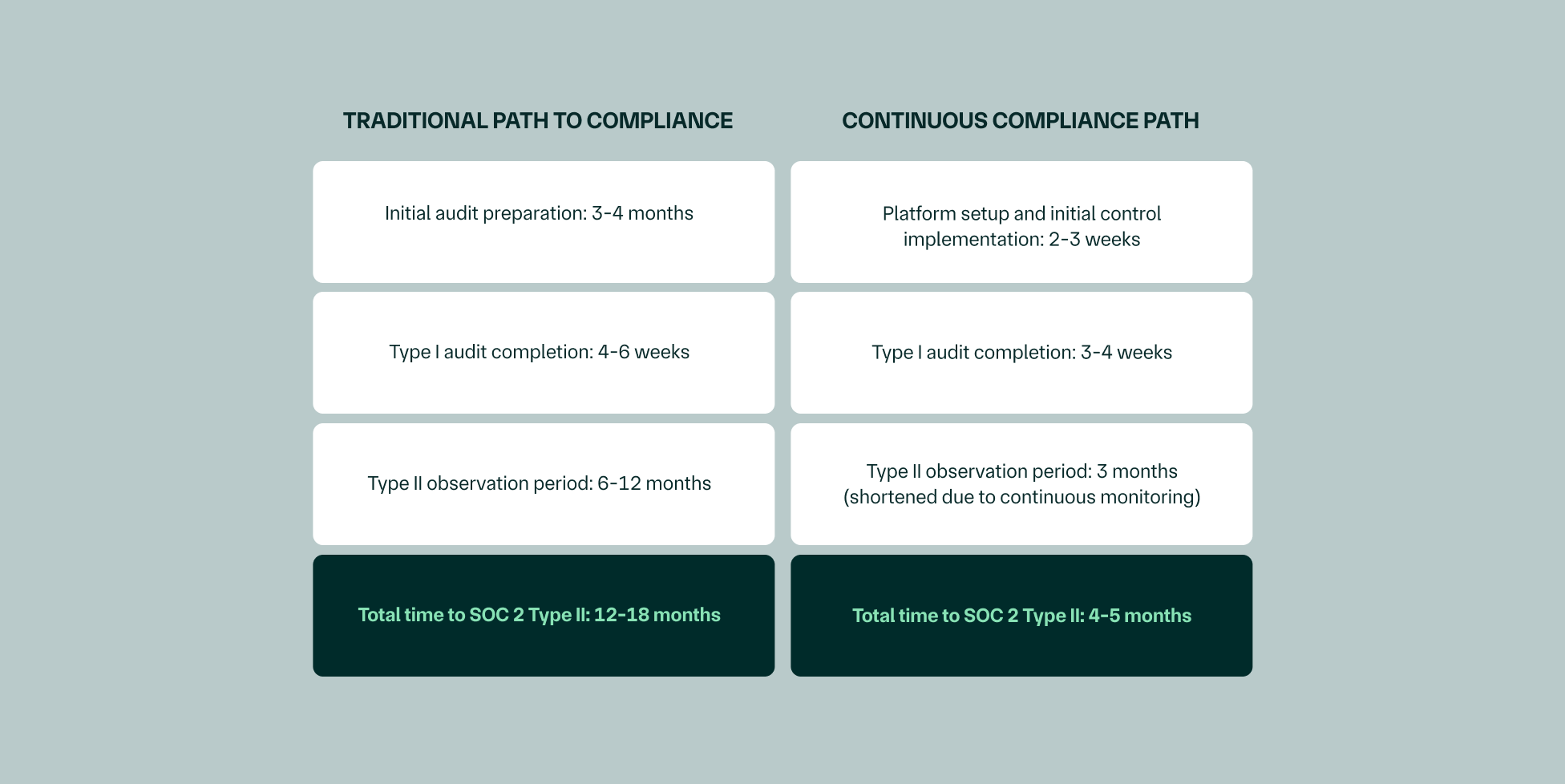
Okay, so the financials look great, but the time savings might just be even more valuable. Think about how long it usually takes to get SOC 2 Type II compliant:
Traditional path to compliance:
Initial audit preparation: 3-4 months
Type I audit completion: 4-6 weeks
Type II observation period: 6-12 months
Total time to SOC 2 Type II: 12-18 months
Continuous compliance path:
Platform setup and initial control implementation: 2-3 weeks
Type I audit completion: 3-4 weeks
Type II observation period: 3 months (shortened due to continuous monitoring)
Total time to SOC 2 Type II: 4-5 months
Time saved: 8-13 months of your team's attention that can stay focused on product development instead of audit preparation.
But even after you've got that initial certification in the bag, the time savings keep on coming. The annual recertification audits that normally take up 4-6 weeks of planning and coordination become pretty much a breeze. Your auditor just logs into your platform, pulls the evidence they need, and that's it.
Hidden value
Beyond direct cost and time savings, continuous compliance creates strategic advantages that are harder to quantify but equally important:
Faster deal cycles translate to higher win rates: When you can respond to security questionnaires in hours instead of weeks, you maintain deal momentum. Prospects don't have time to evaluate three other vendors while waiting for your security documentation.
Multi-framework readiness opens new markets: Each additional compliance framework you pursue (HIPAA, ISO 27001, SOC 1) traditionally requires months of dedicated work. With continuous compliance, adding frameworks becomes incremental because your controls already map to multiple standards.
Engineers stay focused on product, not compliance: Your senior engineers are expensive. Every hour they spend configuring security policies or gathering audit evidence is an hour they're not solving customer problems or building competitive advantages.
Continuous compliance reduces re-audit stress: The annual audit cycle no longer triggers panic. When you're already monitoring everything continuously, the audit becomes a validation exercise rather than a scramble.
Improved customer trust and retention: Enterprise customers increasingly demand evidence of security maturity throughout the relationship—not just at contract signing. Continuous compliance lets you demonstrate ongoing commitment to security, strengthening customer relationships.
How to implement continuous compliance
So how do you actually make this work? Here's the basic plan:
1. Take stock of where you are right now
Before you start implementing continuous compliance, take some time to figure out what you've got to work with:
Inventory all applicable frameworks and regulations (SOC 2, ISO 27001, GDPR, HIPAA, etc.)
Document existing tools, processes, and manual workflows
Identify gaps between current state and continuous compliance
Key questions to ask yourself:
How many hours/month does your team spend on compliance tasks?
How many tools are you managing across GRC, cloud security, vulnerability management, TPRM?
How long does audit prep currently take?
2. Define your compliance requirements
With your current state documented, the next step is establishing clear requirements for your continuous compliance program:
Map controls to applicable frameworks
Establish risk tolerance and prioritization criteria
Determine which processes can be automated vs. which require human judgment
3. Choose the right approach for you
At this point, you've got a choice to make:
Option A: Platform-only approach
Best for: Organizations with dedicated security/compliance teams who can operate the tools
You'll need: Staff to configure, tune, respond to alerts, manage remediation, and interface with auditors
Cost: Platform fees + internal headcount
Option B: Platform + operations approach
Best for: Organizations without large security teams, or those wanting to consolidate vendors
You get: Tools + operational support (GRC analysts, security engineers, audit management)
Cost: Higher platform fee, but eliminates the need for additional headcount and point solutions
Mycroft takes the second approach—we provide the platform and the Risk Operations Center that runs it for you.
4. Implement in phases
Rather than attempting a big-bang transformation, successful implementations follow a phased approach:
Phase 1: Get the basic evidence automation and control monitoring up and running (quick wins)
Phase 2: Integrate risk management and vulnerability workflows
Phase 3: Bring in vendor risk management and continuous auditing
Phase 4: Add the finishing touches with advanced automation and custom integrations
5. Establish feedback loops
Continuous compliance isn't a "set it and forget it" proposition. To really make it work, you need to be willing to keep tweaking and refining:
Regular reviews of alert signal-to-noise ratio
Continuous tuning based on false positives/negatives
Quarterly assessments of whether controls are actually reducing risk
Red flags to watch for:
❌ Don't get caught up in silly promises to get compliant in a week (compliance actually takes time)
❌ Be wary of products that promise automation but actually just drop a bunch of config and tuning work on you (you want to simplify your life, not get a new job)
❌ If the integration support is weak, watch out for gaps in visibility
❌ Audit-focused only tools are basically useless - you want security, not just compliance theater
As you can see, Mycroft was designed to check every box on this list—and to provide the operational support that makes continuous compliance sustainable.
After all this, the question remains…
Continuous compliance isn't just a nice-to-have - it's a must. Regulations are piling up, your infrastructure is getting more complicated by the day, and the cost of not being compliant is just going up and up.
But just getting a tool isn't enough - you need a whole operating model that combines automation, intelligence, and actual operational support.
The real question isn't so much "should I do this" but "how am I going to get it done?"
Are you going to build it from scratch (your own platform + a bunch of headcount)
Are you just going to cobble it together bit by bit (multiple vendors and fragmented visibility)
Or are you going to partner with a company that already has the Risk Operations Center sorted out?
Ready to see what continuous compliance looks like with Mycroft?
Book a demo to learn how our AI-powered Risk Operations Center can consolidate your security stack, automate compliance operations, and free your team to focus on growth—not audits.
FAQs
What is continuous compliance monitoring?
Continuous compliance monitoring is the automated, real-time process of ensuring your organization's security controls, policies, and systems remain aligned with regulatory obligations and industry frameworks, without relying on periodic audits to identify gaps.
How does continuous compliance differ from traditional compliance?
Traditional compliance relies on point-in-time audits (annual or semi-annual), which means compliance drift can go undetected for months. Continuous compliance provides real-time visibility, automated monitoring, and immediate alerting when violations occur.
What are the benefits of continuous compliance?
The key benefits when organizations achieve continuous compliance include:
Always audit-ready (no more scrambling)
Real-time risk visibility and faster remediation
Reduced manual work for security and compliance teams
Lower total cost of compliance (2.7x cheaper than non-compliance) (Ponemon Institute)
Improved security posture (not just checkbox compliance)
What tools do I need for continuous compliance?
At minimum, you need:
GRC platform for control tracking and evidence management
Cloud security scanning (CSPM/CNAPP)
Vulnerability management
Device management (MDM/EDR)
Vendor risk management
However, managing these as separate point solutions creates operational complexity and gaps in visibility. That's why many organizations consolidate into a unified platform like Mycroft, which integrates all five capabilities into a single Risk Operations Center. This approach eliminates tool sprawl, provides centralized visibility across your entire security posture, and includes the operational support to actually run your compliance program—not just monitor it.
Can continuous compliance be fully automated?
Automation handles repetitive tasks like evidence collection and control monitoring, but human oversight is still required for:
Contextualizing alerts and prioritizing remediation
Managing exceptions and edge cases
Interfacing with auditors
Vendor risk assessments
The best solutions combine automation with operational support.
How long does it take to implement continuous compliance?
Implementation timelines vary:
Platform setup and integration: 1-2 weeks
Control mapping and tuning: 2-4 weeks
Full operational maturity: 2-3 months
Organizations with existing compliance programs can often achieve continuous monitoring faster than those starting from scratch.
What frameworks does continuous compliance support?
Continuous compliance can support maintaining continuous compliance for any framework with defined controls, including:
SOC 2 Type I & II
ISO 27001
GDPR, HIPAA, PCI DSS
NIST CSF, CMMC
Custom internal frameworks
How does continuous compliance improve security beyond just audit readiness?
By continuously monitoring controls in real-time, continuous compliance monitoring tools:
Detects vulnerabilities and misconfigurations immediately
Ensures controls are functioning as designed (not just documented)
Provides ongoing risk visibility to inform security decisions
Reduces the gap between "compliant on paper" and "actually secure"
How quickly can we get SOC 2 Type I certified with continuous compliance?
With the right platform and operational support, organizations can typically achieve:
SOC 2 Type I: 4-6 weeks (if controls are already in place)
However, be wary of vendors promising "compliance in one week"—that's usually checkbox compliance, not real security. Quality auditors need time to properly assess your controls.
How does AI improve continuous compliance monitoring?
AI agents can:
Contextualize alerts based on your business environment (reducing false positives)
Prioritize remediation based on actual risk, not just severity scores
Automate vendor risk assessments by analyzing trust center updates and security documentation
Build custom workflows using natural language (no coding required)
Learn from your team's responses to improve accuracy over time
The key is that AI should augment human analysts, not replace them entirely.





.webp)